
From Curiosity to Calling: Building Renton’s Teacher Pipeline (Part 1)
How do you turn high school students into future teachers—and bring them back to serve their own community?
In Part 1 of our conversation recorded in mid-February 2026, we travel to Renton School District in Washington to explore how their Teacher Academy and Educators Rising program has created a thriving “grow your own” teacher pipeline. What began as a single high school program in 2008 has evolved into a comprehensive system that supports students from high school through college and into full-time teaching careers.
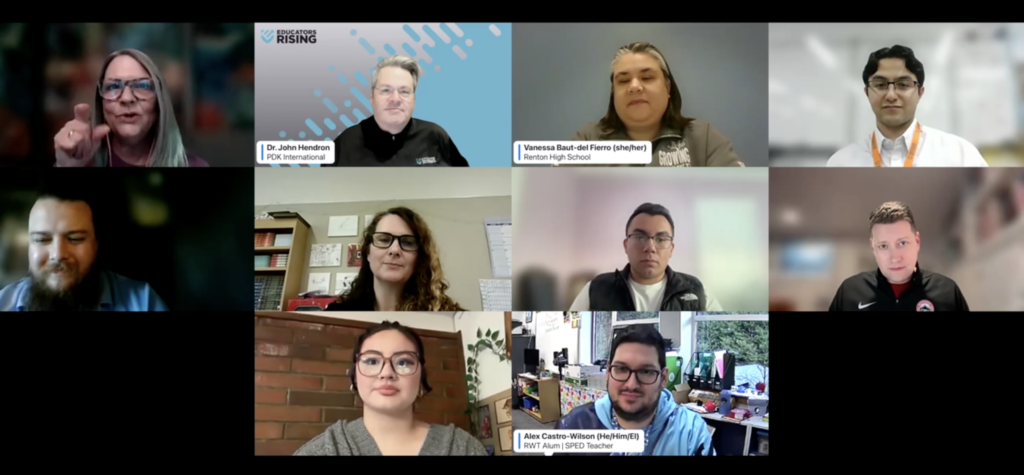
Teacher Academy Coordinator Carla Smith and her “dream team”—including university partners, current students, paraeducators, early-career teachers, and veteran educators—share firsthand how intentional support, mentorship, and community have helped close the leaks that often derail aspiring educators.
A central theme emerges early: this isn’t just a pathway—it’s a pipeline built on relationships, belonging, and long-term investment.
Key Takeaways
Grow-your-own programs work because students already have roots in their communities.
Research shows that 60% of teachers work within 20 miles of where they went to high school. Renton’s program recognizes that the next generation of educators is already sitting in today’s classrooms.
Early exposure and dual credit opportunities accelerate the journey into teaching.
Students earn college credits, gain classroom experience, and even qualify as paraeducators before graduating high school, shortening the path to full-time teaching.
Ongoing mentorship keeps students connected through college and beyond.
Graduates stay involved as Teacher Academy Student Ambassadors (TASAs), providing mentorship, recruiting future educators, and maintaining strong ties to their home district.
Paid internships and work-based learning help students see teaching as a viable career.
Grant-funded opportunities allow students to work with younger learners while still in high school, building skills and confidence while earning income.
Community is the foundation of the pipeline.
Again and again, participants emphasize that relationships—with mentors, peers, and former teachers—are what sustain their commitment to becoming educators.
In This Episode, You’ll Learn
- How Renton built and scaled its Teacher Academy program
- Why dual credit and early field experience make a difference
- How mentorship supports students from high school into careers
- How paid internships help strengthen the pipeline
- Why belonging and community are essential to developing future educators
Memorable Moments
- A graduate returns to teach in the same school district that launched his career
- Students qualifying as paraeducators before graduating high school
- The creation of the Teacher Academy Student Ambassador program
- How one educator describes the pipeline as an “aqueduct” sustained by community
Why This Matters
Districts across the country are facing persistent teacher shortages. Renton’s experience demonstrates that sustainable solutions begin locally—by identifying, supporting, and investing in students who already have a passion for education and a commitment to their community.
As Carla Smith puts it, the goal isn’t simply to prepare students and send them on their way. It’s to help them belong—and to welcome them back.
📹 You can watch this podcast via YouTube.
© 2026 PDK International

Recent Comments